
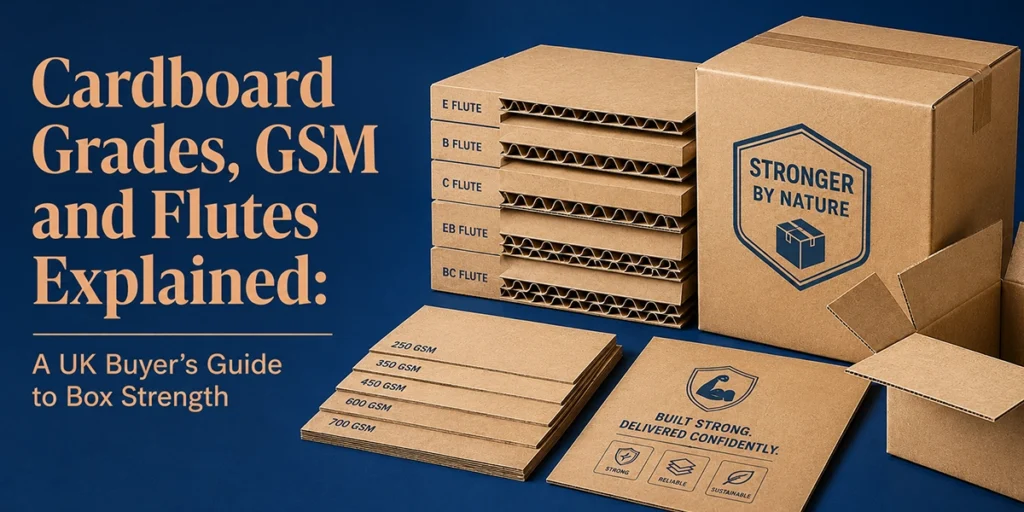
Cardboard Grades, GSM and Flutes Explained: A UK Buyer’s Guide to Box Strength
Quick answer GSM is simply the weight of the paper in grams per square metre. It tells you how heavy the board is, not how strong the finished box will be. Real box strength comes from the flute (the wavy layer), the wall count and the liner quality. Most UK e-commerce parcels ship happily in single-wall B or E flute. You only need double wall past roughly 10 to 15 kg.
You’ve asked a packaging supplier for a quote and the reply reads like code: “125K/B/125T, single wall, E-flute option available, 350gsm SBS for the retail carton.” Nobody explains what any of it means. Then you’re expected to sign off hundreds of boxes on the strength of it.
This guide translates all of it. We quote these specs every day for UK small businesses at All Custom Packaging, and the same questions come up on nearly every first order. By the end you’ll be able to read a board grade, pick the right flute and, just as usefully, spot when you’re being sold more board than your product needs.
What does GSM mean on cardboard?
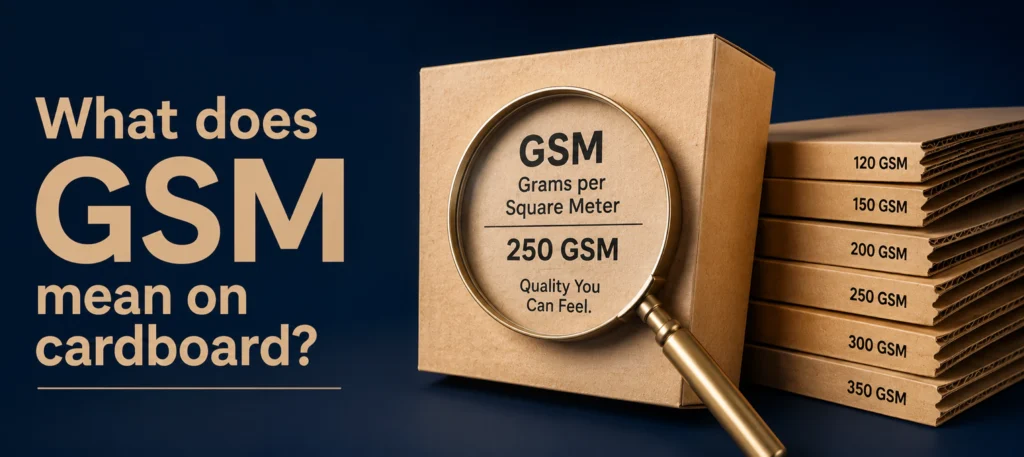
GSM stands for grams per square metre: the weight of one square metre of the material. A 350gsm board weighs 350 grams per square metre. That’s the whole definition. It measures paper weight and density, not the structural strength of a finished box.
Definition: GSM Grams per square metre. The standard weight measure for paper and board across the UK printing and packaging trade. Higher GSM means heavier, denser material. It does not, on its own, mean a stronger box.
Numbers on a page mean little until you can feel them, so here are real-world anchors:
| GSM | Feels like | Typical packaging use |
| 250gsm | A sturdy greetings card | Budget product cartons, sleeves, inserts |
| 350gsm | A premium business card, with a firm snap | Cosmetic cartons, retail folding boxes |
| 700gsm | A hardback book cover | Heavy-duty cartons, luxury sleeves |
| 1,200gsm | Rigid greyboard, about 2mm thick, won’t bend by hand | Rigid gift boxes, phone-style boxes |
Worth knowing: corrugated board is rarely described by a single GSM figure. Its liners are quoted separately (usually 115 to 200gsm each), because the strength story sits in the structure between them. Which brings us to flutes.
What are cardboard flutes, and which type do you need?
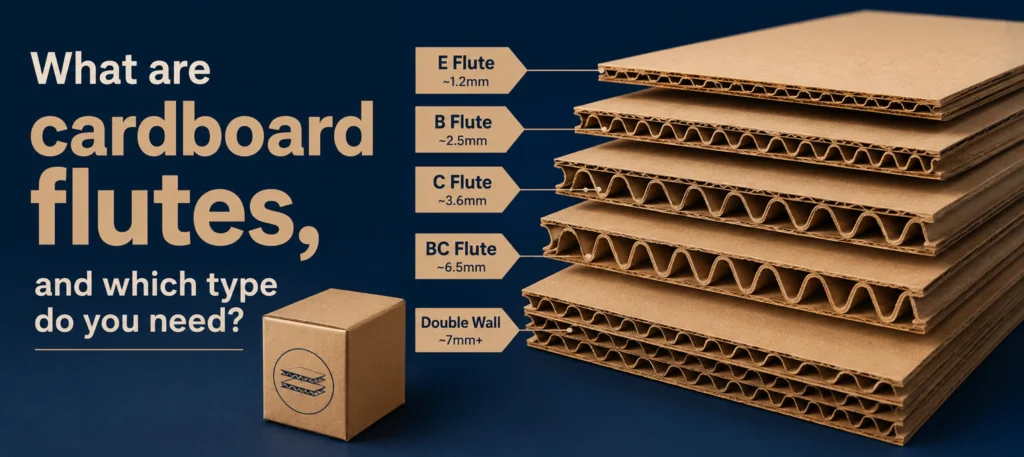
The flute is the wavy, arched layer glued between the flat liners of corrugated board. Those arches act like rows of tiny bridges. They resist crushing, absorb knocks and add stiffness without adding much weight. Flute profiles run from chunky A-flute down to whisper-thin F-flute.
Definition: Flute The corrugated (wavy) paper layer sandwiched between flat liner papers. Taller flutes cushion better and stack stronger; finer flutes fold sharper and print better. The letters (A, B, C, E, F) refer to the order each profile was invented, not their size.
Here’s how the five common profiles compare:
| Flute | Thickness | Strengths | Best for |
| A | ~5mm | Best cushioning and stacking strength | Fragile or heavy goods, industrial packing |
| C | ~3.5 to 4mm | All-round compression strength; the industry default | Shipping cases, e-commerce outers |
| B | ~3mm | Good crush resistance, folds and die-cuts cleanly | Mailer boxes, retail-ready shippers |
| E | ~1.5mm | Smooth print surface, crisp folds, slim profile | Printed mailer boxes, retail packaging |
| F | ~0.6 to 1mm | Finest surface, near-carton print quality | Small luxury boxes, cosmetics, food service |
Corrugated Flute Thickness Compared
A-flute is approximately 5mm thick, C-flute 4mm, B-flute 3mm, E-flute 1.5mm and F-flute 0.8mm. Taller flutes cushion better; finer flutes print better. Trade-standard ranges. Flute thickness at a glance (mm) A flute 5.0 C flute 4.0 B flute 3.0 E flute 1.5 F flute 0.8 Thicker flutes cushion and stack; finer flutes fold and print Source: trade-standard flute profiles, verified against UK supplier guides (2026) Flute thickness compared: A-flute for cushioning down to F-flute for print-quality luxury boxes. A rough rule from our quoting desk: C-flute for plain shipping cases, B or E for anything printed that a customer will open, F when the box is part of the product’s shelf appeal. C-flute is the most widely produced profile in the trade, which is exactly why couriers’ handling systems are built around it.
Single wall, double wall or triple wall?
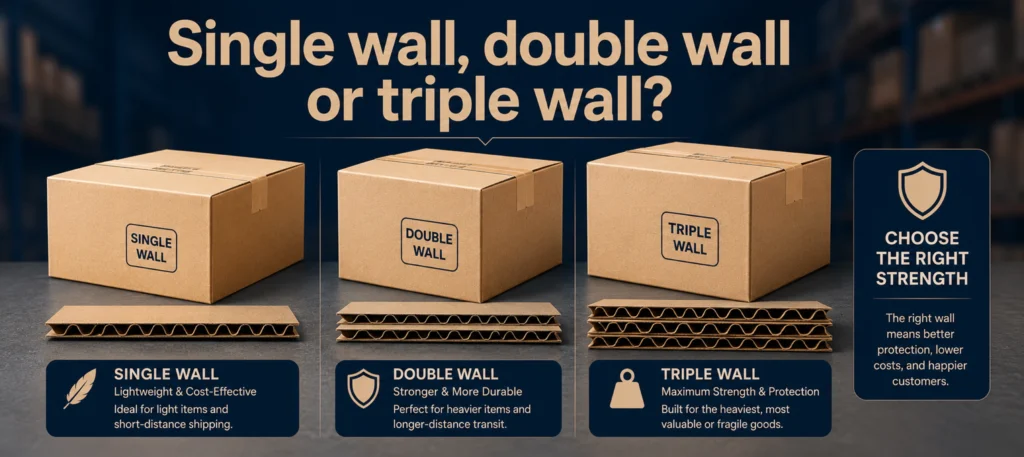
Wall count is the number of flute layers in the board. Single wall (one flute, two liners) handles most jobs up to about 10 to 15 kg. Double wall (two flutes, three liners) roughly doubles stacking strength for 15 to 30 kg loads. Triple wall is export-crate territory.
Definition: Wall One “wall” = one flute layer plus its liners. Single wall is 3 to 4mm thick, double wall 6 to 7mm, triple wall 10 to 12mm. Each added wall increases crush resistance, weight and cost.
Double wall boards usually pair two flute sizes. BC board (B + C flutes, 6 to 7mm) is the heavy-lifting standard. EB board (E + B, around 4 to 4.5mm) keeps a fine printing surface on the outside with extra rigidity behind it, which is why it’s popular for premium subscription boxes.
Can single wall really take 15 kg? With the right grade, yes. The most common mistake we see on first orders isn’t under-speccing. It’s paying for double wall to ship 2 kg of candles.
How to read a board grade like 125K/B/125T
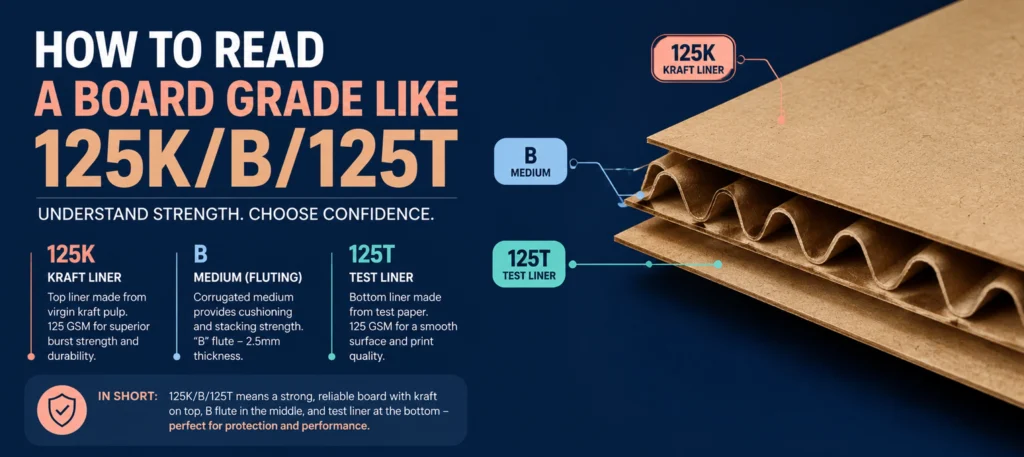
That string is outer liner / flute / inner liner. So 125K/B/125T means a 125gsm kraft outer liner, B-flute, and a 125gsm test inner liner. Once you know the pattern, every corrugated quote in the UK reads the same way.
Definition: Kraft vs test liner Kraft (K) is made mainly from virgin fibre: stronger, smoother and better for print. Test (T) liner is recycled: slightly weaker, cheaper, and perfectly good for inner faces or unprinted shippers.
Two strength measures sometimes appear alongside the grade:
Definition: ECT and burst strength ECT (edge crush test) measures how much stacking force the board edge can take before it buckles, which predicts pallet-stacking performance. Burst strength (the Mullen test) measures resistance to a puncture through the face. UK suppliers spec most e-commerce work by grade and flute; ECT matters once you’re stacking pallets.
For a typical UK e-commerce parcel under 10 kg, 125K/B/125T or its E-flute equivalent covers you. Move up to 150 or 200gsm liners for dense products, sharp edges or rough multi-courier journeys.
SBS, kraft or CCNB: which carton board for retail packaging?

Not everything is corrugated. Folding cartons (think cosmetics boxes, tea cartons, product sleeves) use solid carton board, and three names dominate quotes.
SBS (solid bleached sulphate) is virgin-fibre board, bright white right through, with the best print and foil-stamping surface. It’s the default for cosmetics and premium retail. Kraft board keeps its natural brown fibre look: strong, recyclable and on-brand for eco-positioned products. CCNB (clay-coated news back) is recycled board with a white coated print face and a grey back: the budget-friendly option for inner cartons and value lines.
The honest trade-off: SBS costs the most and looks the sharpest. CCNB saves money but the grey interior can read as cheap in an unboxing. Kraft sits between, and buyers increasingly choose it for the sustainability story as much as the price. If you’re weighing carton formats against rigid board, our guide to folding cartons vs rigid boxes goes deeper, and you can see finished examples on our rigid boxes page.
Which spec does your product actually need?

Here’s the table we wish every first-time buyer had. It condenses what we quote day in, day out across thousands of UK orders. Treat it as a starting point; exact grades shift with product weight and courier route, and prices vary by size and quantity.
| Product type | Recommended spec | Why it works |
| Jewellery | 1,200gsm rigid greyboard box, or 350gsm SBS carton with insert | Presentation matters more than crush strength; rigid board carries the premium feel |
| Cosmetics & skincare | 350gsm SBS or kraft folding carton; E or F flute corrugated for postal sets | Fine print surface for branding; micro-flute adds protection without bulk |
| Candles & glassware | E-flute mailer with divider insert, 125K liners minimum | Micro-flute cushions glass; the insert stops contents colliding, which causes most breakage |
| Food (dry goods) | 300 to 350gsm food-safe carton or E-flute box | Food-contact compliant liners; check GOV.UK food contact materials guidance for direct-contact products |
| Apparel & textiles | Single wall E or B flute mailer, 250 to 350gsm carton for folded items | Light contents need presentation and fit, not heavy board |
| E-commerce parcels under 10 kg | Single wall B or C flute, 125K/B/125T typical | Handles UK courier networks without paying for unused strength |
| Heavy or multi-unit shipments 15 to 30 kg | Double wall BC board, 150gsm+ liners | Stacking strength for pallets and depot handling |
A candle brand came to us last year shipping single units in double-wall C-flute cases with void fill. We moved them to an E-flute mailer with a die-cut insert. Breakages didn’t rise, the unboxing looked better, and the box cost and parcel weight both dropped.
The over-speccing trap: when thicker board wastes money

Thicker board is not always better. Past the strength your product actually needs, every extra gram of board is money spent on nothing: higher unit cost, heavier parcels, higher courier bills and more storage bulk. Industry guidance echoes what we see in quoting: a blanket switch to double wall across all products is rarely cost-effective (365 Retail).
Three ways over-speccing quietly drains margin:
- Unit cost. From our own quoting, stepping from single-wall E-flute to double-wall board typically adds a meaningful chunk to the per-box price. Multiply that across 1,000 units and it’s often the difference of a full print upgrade.
- Shipping weight and size. Double wall adds thickness on every face. A box that creeps over a courier’s size or weight band pays the higher rate on every single parcel. Check current Royal Mail and courier bands before you spec; a slimmer flute sometimes drops you a whole price tier.
- Storage and waste. Thicker board means fewer flat-packed boxes per stack, and your customer pays too: bulkier recycling and a “why is this box so huge?” unboxing.
One caveat here. Under-speccing costs more than over-speccing when it goes wrong, because damage triggers refunds, replacements and lost customers. The fix isn’t defaulting to the thickest board. It’s matching the spec to the product, and testing. Order a sample, load it, and send it through the actual courier journey before committing. Oversized boxes with shifting contents cause more transit damage than thin walls do; if breakage is your worry, pair the right grade with a proper internal fit rather than more flute. Our guide to protective packaging covers inserts and void fill in detail, and our box dimensions guide helps you get the size right in the first place.
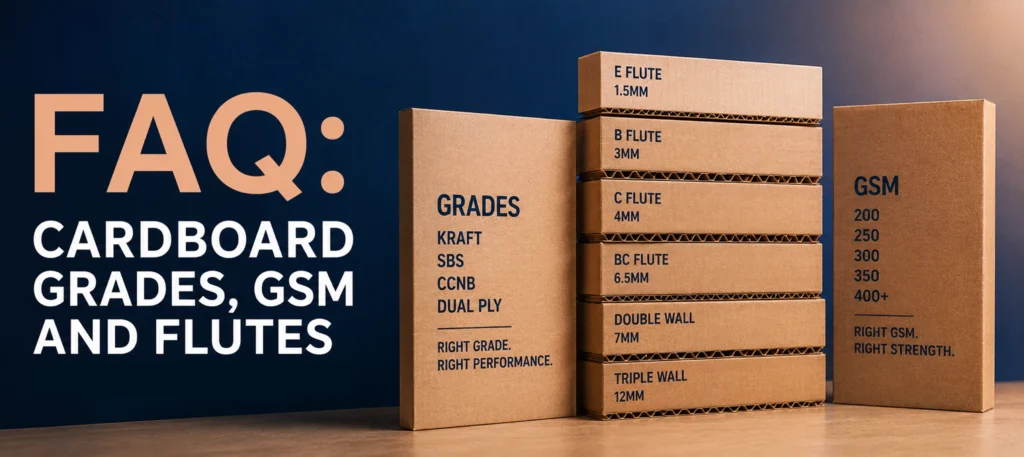
FAQ: cardboard grades, GSM and flutes
Is higher GSM cardboard stronger?
Not automatically. GSM measures paper weight, not box performance. A well-constructed 125gsm kraft-lined B-flute board can outperform a heavier board with recycled liners and a poorly matched flute. Strength comes from the combination of liner quality, flute profile and wall count.
What GSM is a standard cardboard box?
A typical single-wall UK shipping box uses liners of 125 to 150gsm either side of the flute, quoted as a grade such as 125K/B/125T. Retail folding cartons usually run 250 to 350gsm, and rigid gift boxes use greyboard of roughly 1,000 to 1,500gsm.
What’s the difference between B flute and E flute?
Thickness and finish. B-flute is about 3mm thick and prioritises crush resistance, which suits shippers and mailers. E-flute is about 1.5mm, folds sharper and takes finer print, which suits retail and branded mailer boxes. Many premium boxes combine both as EB double wall.
Which cardboard is best for shipping boxes?
Single-wall C or B flute covers most UK parcels up to about 10 to 15 kg. Go double wall (BC board) for 15 to 30 kg, palletised stock or fragile-plus-heavy items. Printed e-commerce mailers usually use B or E flute for the cleaner surface.
What does 125K/B/125T mean on a packaging quote?
Outer liner, flute, inner liner, in that order. 125K/B/125T is a 125gsm kraft outer, B-flute centre and 125gsm recycled test inner. Swap the letters and numbers and you can read any UK corrugated grade.
Are heavier-duty boxes worth it for fragile products?
Usually the internal fit matters more than the wall count. A snug insert in single-wall E-flute protects glass better than a roomy double-wall box where the product rattles. Add board grade only after the fit is right.
Key takeaways
- GSM is paper weight per square metre, not a strength score. Structure (flute + wall + liners) determines how a box performs.
- Flutes in one line: A cushions, C ships, B folds, E prints, F impresses.
- Read grades as outer/flute/inner: 125K/B/125T = 125gsm kraft outer, B-flute, 125gsm test inner.
- Single wall handles most UK parcels under 10 to 15 kg; double wall is for genuinely heavy or stacked loads.
- Over-speccing wastes money three ways: unit cost, courier weight bands and storage. Match the spec to the product and test with a sample.
Still not sure which grade fits your product? That’s literally the first thing we work out on every order. Send us what you’re shipping and we’ll spec the board with you, with free design support and no setup fees, from 100 units. Get a quote from All Custom Packaging.