
How Much Do Custom Rigid Boxes Cost in the UK?
Quick answer: how much do custom rigid boxes cost in the UK? For a printed, medium-sized box, one detailed UK price list published in 2026 runs from about £8 to £14 each at 100 units. That falls to roughly £4 to £6 each at 1,000 units, with small jewellery boxes cheaper and large hamper boxes several times dearer. The unit price is only part of the bill: VAT, any one-off tooling, samples, the number of designs and the space pre-assembled boxes take up all add to what the order really costs.
Most UK suppliers do not publish rigid box prices at all, and the few guides that do tend to stop at the unit price. This one gives you realistic numbers, explains what moves them, and then adds up the parts of the bill a price per box leaves out.
What a custom rigid box costs in 2026
The clearest public reference is a UK supplier’s 2026 price list for a standard lid-and-base rigid box: 200 x 150 x 70 mm internal, 2 mm greyboard, a full-colour printed wrap. Treat these as market orientation, not a quote. Every supplier prices differently, and your own specification will move the figure.
| Quantity | Matte lamination | Soft-touch lamination | Soft-touch plus gold foil |
|---|---|---|---|
| 100 | £8.40 | £10.20 | £12.00 |
| 250 | £6.30 | £7.65 | £9.00 |
| 500 | £5.10 | £6.30 | £7.50 |
| 1,000 | £4.35 | £5.40 | £6.30 |
| 2,500+ | £3.15 | £3.90 | £4.65 |
Source: one UK supplier’s published 2026 price list, checked September 2026. Prices per box, excluding VAT.
Size moves the price even more than quantity does. On the same list, at 500 units with soft-touch and one foil colour:
| Box size (internal) | Typical contents | Price per box at 500 |
|---|---|---|
| 80 x 60 x 30 mm | Ring, earrings | £3.20 |
| 140 x 100 x 50 mm | Single candle, skincare | £5.40 |
| 200 x 150 x 70 mm | Cosmetics set | £7.50 |
| 300 x 220 x 90 mm | Clothing, multi-product set | £11.20 |
| 420 x 300 x 120 mm | Hamper, corporate gift | £16.80 |
This shape is typical of custom packaging pricing, although the exact curve varies by supplier and specification: on this list the first 100 boxes are the most expensive, and the price per box roughly halves by 1,000. Bigger boxes cost more, but less than in proportion to their volume. On this list the 300 x 220 x 90 mm box holds nearly three times as much as the 200 x 150 x 70 mm one for about one and a half times the price. The hand work per box does not triple with the size.
Why a rigid box costs more than a folding carton
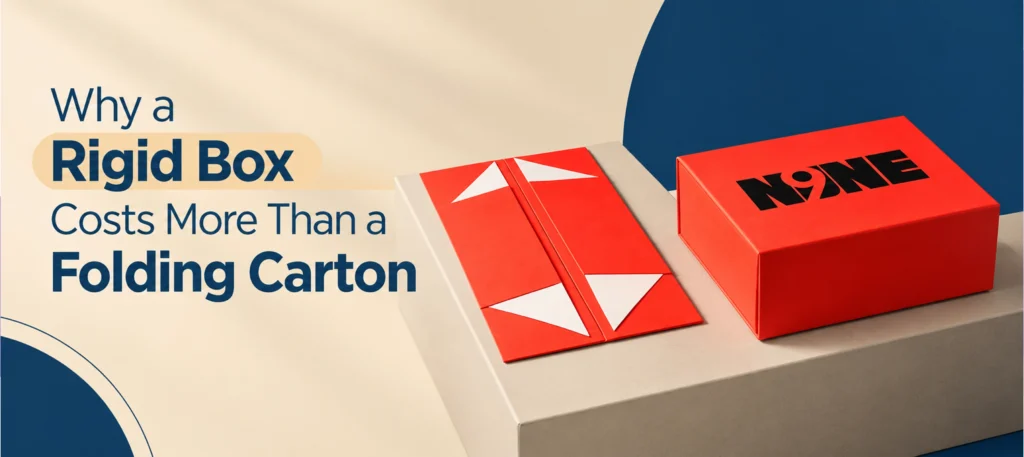
A folding carton is printed, cut and glued flat by machine, then folded up by whoever packs it. A rigid box is built from thick greyboard that never folds, wrapped in a separately printed and laminated sheet, and it arrives already made up. Much of that wrapping and assembly is done by hand, which is why the step from carton to rigid is a jump rather than an increment. Our guide to how rigid boxes are made walks through each stage, and if you are still deciding between the two formats, folding cartons vs rigid boxes covers that choice on its own.
The seven things that set your price
| Driver | What pushes the price up | Published add-on range (per box) |
|---|---|---|
| Size | More board, more wrap, more hand work | See the size table above |
| Board thickness | Thicker greyboard is heavier and costs more to wrap cleanly | Around £1 per box between 1.5 mm and 2 mm at 500 units |
| Surface finish | Soft-touch lamination over matte | £1.20 to £2.00 |
| Decoration | Foil, embossing, spot UV | Foil £0.80 to £1.80, emboss £0.60 to £1.20, spot UV £0.40 to £0.80 |
| Closure style | Magnetic flap over a simple lid and base | Magnetic £1.20 to £2.40 |
| Inserts | Foam or card inserts, velvet lining | Card £0.15 to £0.40, EVA foam £0.30 to £0.80 |
| Quantity and designs | Fewer boxes per design, more designs | See the quantity table above |
Add-on ranges from the same 2026 UK price list, at 100 to 500 units.
- Size. Measure the product, add the insert, then size the box around both. A box that is a few millimetres too big on every side wastes board on every unit, and the saving from getting it right repeats on every order.
- Board thickness. Rigid boxes are commonly made from greyboard somewhere between about 1.2 mm and 2.4 mm. Thicker board feels weightier in the hand and costs more. For light products, a thinner board often looks identical on the shelf.
- Finish and decoration. In our view, one well-placed finish often does more than three competing ones. Foil on the logo, on a soft-touch wrap, is a common premium combination. Each extra finish adds to the price per box, so it is worth asking what each one adds to the look before you add it. Our guide to packaging print finishes explains what each one actually does.
- Closure style. A plain two-piece box with a lift-off lid is the simplest rigid construction. Rigid boxes with lids are the usual starting point on cost. Magnetic closure rigid boxes add the magnets, a hinged flap and more wrapping, which is why they sit a pound or two higher per box.
- Inserts. An insert holds the product in place and does a lot of the presentation work. A die-cut card insert is the lighter option on cost. Foam and velvet-lined luxury box inserts cost more but suit heavier or fragile products such as glass bottles and watches.
- Quantity and number of designs. The fixed work of setting up a run is shared across every box in it, so the price per box falls as the quantity rises. The general maths behind that sliding scale is covered in our guide to custom packaging cost and MOQs. The part people often miss is the number of designs. Suppliers count designs against their minimum in different ways, so ask how yours does before you plan a range. At All Custom Packaging, the 100-unit minimum applies per design.
What the unit price leaves out
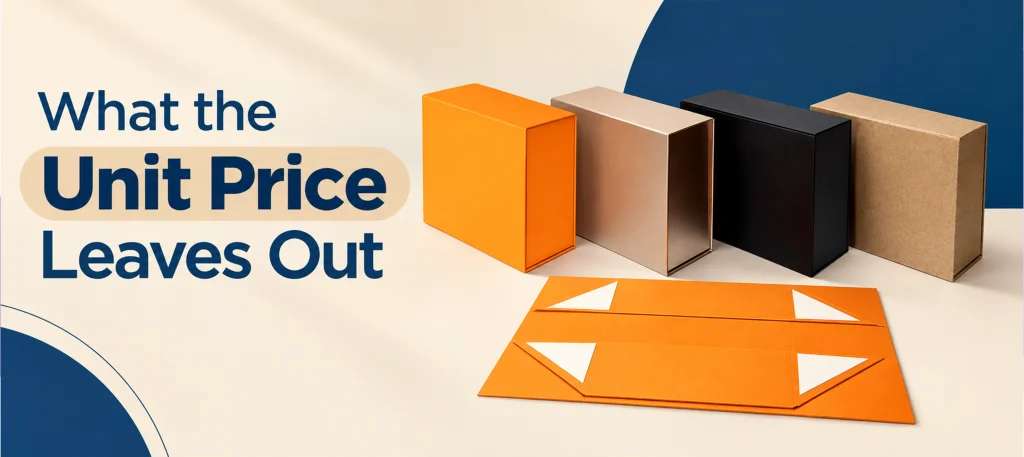
A price per box is the number suppliers lead with. It is not what the order costs. Before comparing quotes, add up these.
- VAT. Most packaging price lists are shown before VAT, and the standard UK VAT rate is 20%. A VAT-registered business can usually reclaim it. A business that is not registered pays it as a real cost, which puts a fifth on top of every quoted figure.
- One-off tooling. Some suppliers list foil blocks, embossing dies or cutting formes as separate one-off charges. The price list above, for example, adds £80 to £180 for a foil or embossing die. Ask every supplier whether their price includes these, so you are comparing like with like.
- Samples. A digital mock-up shows layout. To judge the real board, wrap and finish you need a physical sample, or a video of it. Ask whether a physical sample is available and what it costs before you commit.
- Delivery. Rigid boxes are bulky and heavy for their count, so delivery can be a real line on the invoice. Check whether it is included.
- Storage. This is the cost almost nobody prices in. Rigid boxes usually arrive fully assembled, so they take up their full volume from day one. A thousand boxes at 200 x 150 x 70 mm internal is about 2.1 cubic metres before you count the outer dimensions and the shipping cartons. If you are storing at home or paying for warehouse space, custom collapsible rigid boxes keep the rigid look but fold flat until they are needed.
A worked example
Take 250 medium boxes with soft-touch lamination and one foil colour, at £9.00 each on the price list above:
| Line | Cost |
|---|---|
| 250 boxes at £9.00 | £2,250.00 |
| Foil die (one-off, at that supplier) | £80.00 to £180.00 |
| Subtotal before VAT | £2,330.00 to £2,430.00 |
| VAT at 20% | £466.00 to £486.00 |
| Total including VAT | £2,796.00 to £2,916.00 |
That is £11.18 to £11.66 per box once VAT and tooling are in, against a headline £9.00, before any delivery charge or sample. The boxes will also need about half a cubic metre of storage.
Do Plastic Packaging Tax and EPR add to the cost of a rigid box?
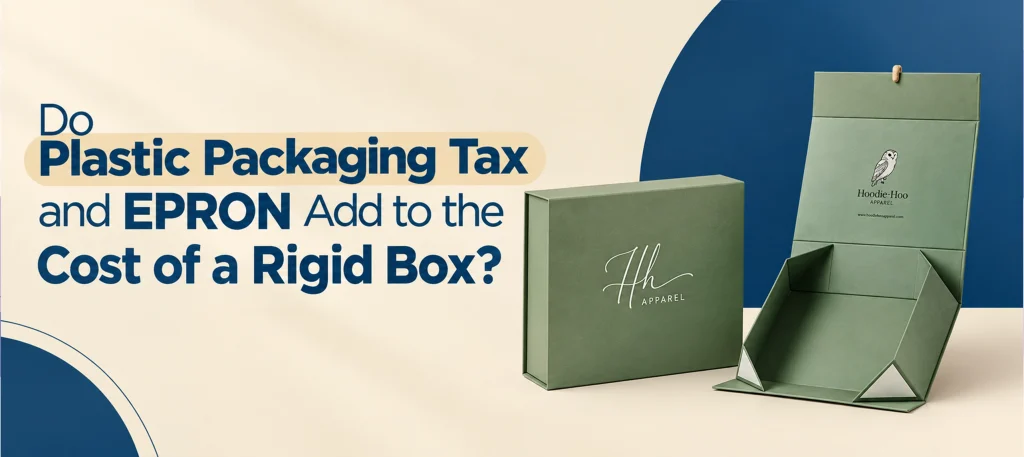
Some pricing guides list both as rigid box costs. For many smaller brands buying standard paper-based rigid boxes, neither will appear as a direct per-box charge, but whether either applies depends on the business and the packaging. Here is how each one works.
- Plastic Packaging Tax. The tax is £228.82 per tonne from 1 April 2026, on plastic packaging components that contain less than 30% reprocessed plastic. It is paid by businesses that make or bring into the UK at least 10 tonnes of plastic packaging in a 12-month period, not by a brand buying boxes made in the UK. It also only applies to a component where plastic is the heaviest material by weight. A greyboard box with a paper wrap is a paper and board component, so a thin laminate on its surface does not make it plastic packaging. A separate foam insert is a plastic component in its own right, but the tax on it falls on whoever makes or imports it at that 10-tonne scale.
- Packaging EPR. Extended producer responsibility fees are paid to PackUK by large producers only: businesses with more than £2 million turnover that handle more than 50 tonnes of packaging a year, and the fees are charged on household packaging. Smaller obligated businesses register and report their packaging but do not pay these waste fees. If you are a large producer, the fee on paper and card was £196 per tonne in 2025. From 2026 the fee is adjusted by a red, amber or green rating given to each type of packaging, so do not assume a particular box earns the lower rate. The illustrative 2026 to 2027 fees for paper and board run from £190 to £250 per tonne, flagged by the government as likely to change.
To put that in proportion: if each of your boxes weighs 250 g (weigh a sample of your own to check), 1,000 boxes are a quarter of a tonne. At £196 per tonne that is £49, or about 5p a box. Even at the highest illustrative rate it is about 6p. For a large producer EPR is a real line to budget, but it is pennies per rigid box, not pounds.
How to bring the price down without making the box look cheaper
- Size the box to the product plus the insert, not to a round number.
- Consider one hero finish. A single foiled logo can carry a premium look on its own, and each extra finish adds cost.
- Start with a lid and base. Move to a magnetic closure only if the opening moment genuinely matters for the product.
- Print the outside only, unless the inside is part of the reveal.
- Order the realistic volume, not the cheapest-looking tier. A lower unit price on boxes that sit unused for two years is not a saving once storage is counted.
- Keep the number of designs down. One box with a changeable sticker or insert card can replace several printed designs.
- Consider collapsible if storage space is tight.
What to send for an accurate quote
A supplier can only price what it is told. Send:
- the product’s dimensions and weight
- the box style (lid and base, magnetic, drawer, collapsible)
- the quantity, and how many designs
- the finish you want, and any insert
- your artwork, or a rough idea of it
- the date you need the boxes by
With those, a quote can be exact rather than a range, and you can compare suppliers on the same specification.
How pricing works at All Custom Packaging
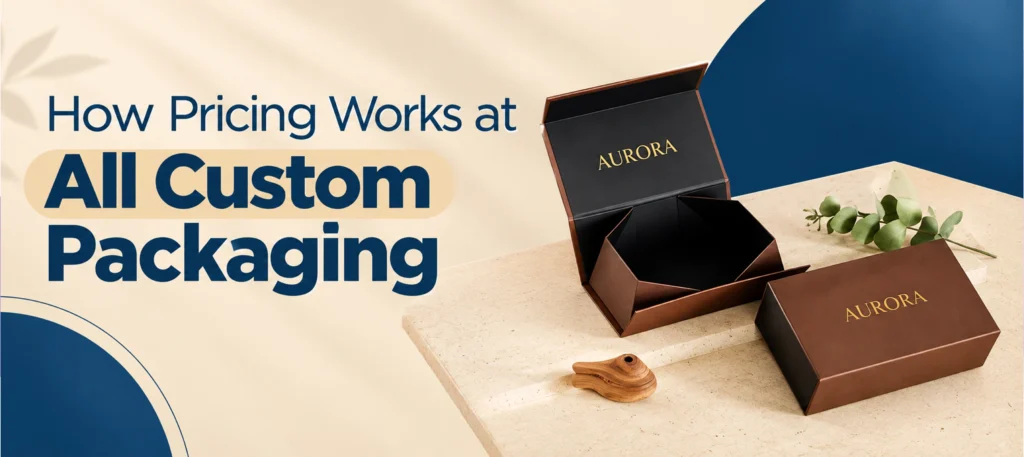
We quote every rigid box to its own specification rather than from a fixed price list. Size, board, finish, closure and insert change the price too much for one table to be honest. What is fixed is how we work:
- There are no setup fees.
- Orders start from 100 units, and the 100-unit minimum applies per design.
- Design support is free, and a digital 3D mock-up is free.
- Every order is approved before bulk production. Approval may be based on a digital 3D mock-up, a video of the physical sample, or a physical production sample, depending on the order. Where a physical sample is part of the agreed workflow, its cost and timing are confirmed at quotation stage.
- Standard production takes 6 to 8 business days after approval.
- UK delivery is free. Delivery time is additional to production. UK delivery usually takes around 4 to 5 business days after production is complete, depending on the delivery address and courier service.
Frequently Asked Questions
How much does a custom rigid box cost per unit in the UK?
On one detailed UK price list published in 2026, a printed medium rigid box costs about £8 to £14 at 100 units and about £4 to £6 at 1,000 units, before VAT. Small jewellery boxes can be under £4 at volume, and large hamper boxes can pass £16 each.
Why are rigid boxes so much more expensive than folding cartons?
A rigid box uses thick greyboard that never folds, a separately printed and laminated wrap, and a lot of hand assembly, and it is delivered made up. A folding carton is thinner board, printed, cut and glued flat by machine. The extra material and hand work is where the price difference comes from.
What is the cheapest way to get a custom rigid box?
Choose a simple lid-and-base construction, size it tightly to the product, print the outside only, use one finish, and order in a quantity you will actually use. Each of those takes cost out, and none of them has to make the box look plain.
Is a magnetic rigid box much more expensive?
On the published 2026 list used in this guide, a magnetic closure adds roughly £1.20 to £2.40 per box at 100 to 500 units compared with a standard lid and base. The magnets, the hinged flap and the extra wrapping account for the difference.
Do small brands pay EPR fees or Plastic Packaging Tax on rigid boxes?
Often not, but it depends on the business. EPR waste fees are paid only by businesses with more than £2 million turnover handling more than 50 tonnes of packaging a year. Plastic Packaging Tax falls on UK makers and importers of at least 10 tonnes of plastic packaging, and a greyboard rigid box is not a plastic packaging component.
Do rigid box prices include VAT?
Most UK packaging price lists are shown before VAT, which is charged at the standard 20% rate. Check every quote for whether VAT, tooling and delivery are included before comparing them.
If you would like a real price for your own box rather than a range, send us the product size, the quantity and the finish you have in mind. We will quote your exact specification, and design support and a digital 3D mock-up are free while you decide.