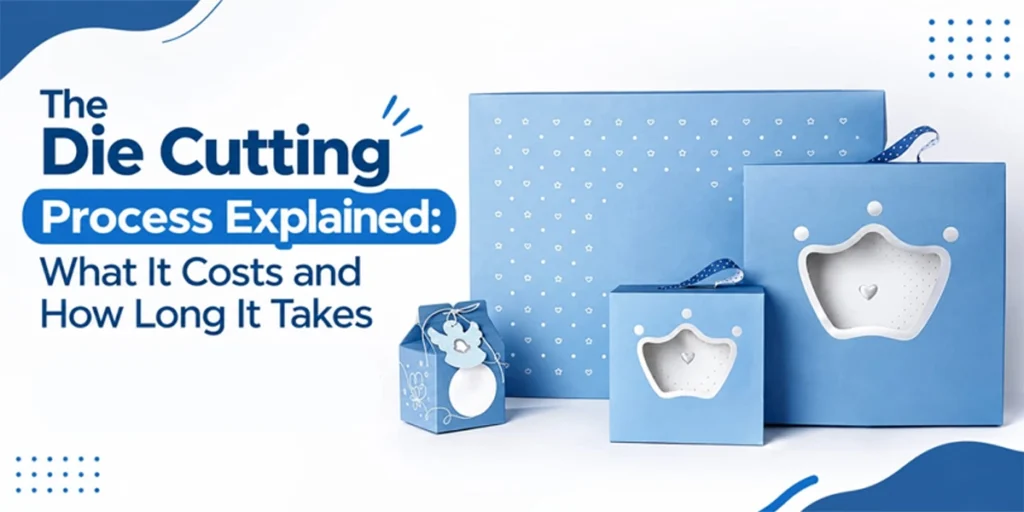
The Die Cutting Process Explained: What It Costs and How Long It Takes
Quick answer: Die cutting is the manufacturing step that presses a shaped steel blade through flat board to cut your box out, together with its folds, slots and windows, in one pass. The tool doing the pressing is called a cutting die, and it has to be built for your specific box shape before a single sheet gets cut. That matters to a buyer for two reasons that most explainer articles skip. A bespoke cutting forme is a one off cost, which UK packaging supplier Sarcina Packaging puts at roughly £150 to £700 plus VAT for a typical job, and building it sits ahead of production in the schedule rather than alongside it. There are no setup fees at All Custom Packaging, so that tooling charge will not appear as a line on your quote, but the die making step still occupies real days in your timeline, and that is the part worth planning around.
Most guides to die cutting are written from inside the factory. They explain how a die board is laser cut and how steel rules get bent, which is genuinely interesting, and then they stop before answering the question you actually asked, which is what any of it means for your order. This guide runs the other way round. It starts with the two things die cutting changes for a buyer, cost and time, and works backwards into the process only as far as you need to understand those two answers.
Die cutting versus a dieline: two different things
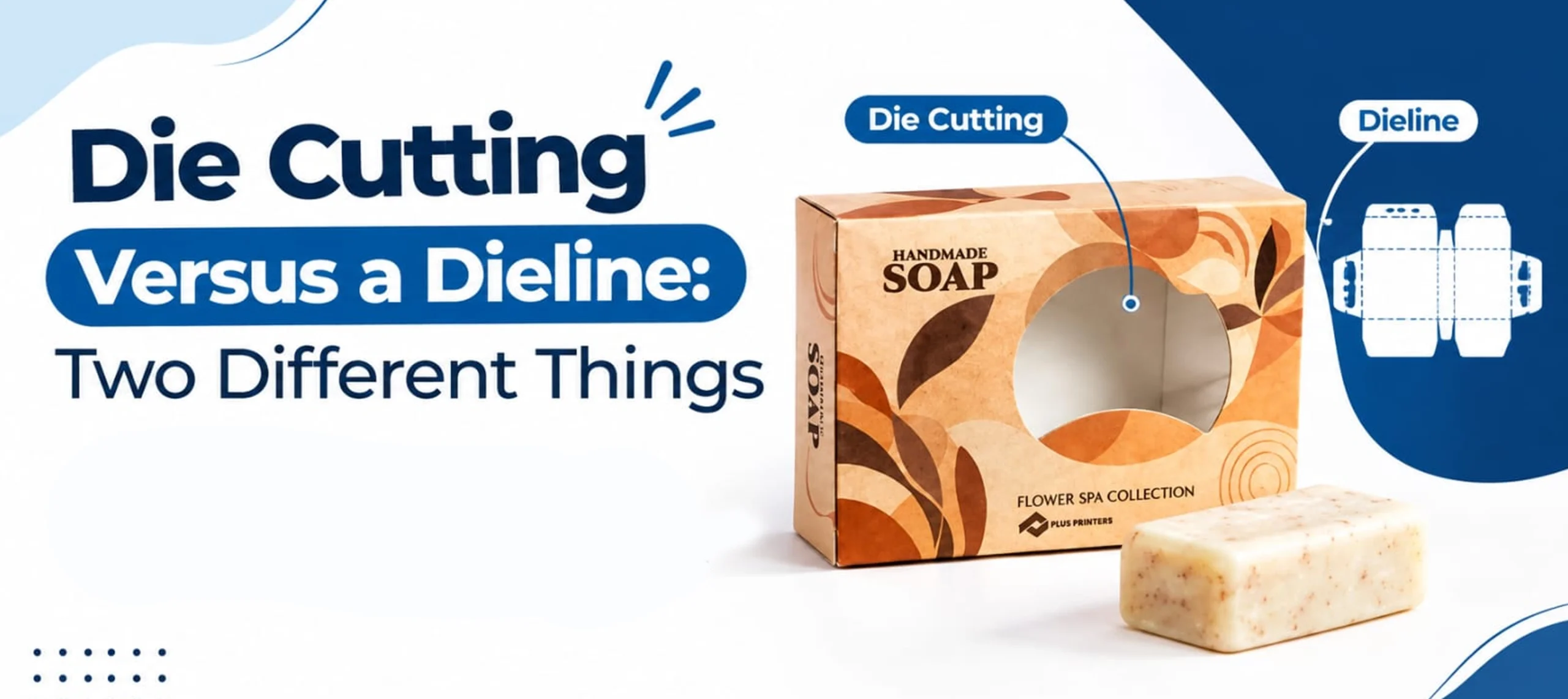
A dieline is a flat drawing. A die is a physical tool. People use the words interchangeably and it causes real confusion when a supplier asks for one and gets the other.
Your dieline is the two dimensional artwork template that shows where your box will be cut, where it will fold and where the glue tab sits, all laid out flat. It is a file. Die cutting is the physical manufacturing process in which a steel tool is pressed through board to make those cuts happen for real. The dieline comes first, then the die is built from it, then the board goes through the press.
If what you actually need is help preparing or reading that flat template, our guide to what a dieline is in packaging and printing covers the file side properly, including how to read the colour conventions on one. This post is about what happens after that file is signed off.
What is die cutting in packaging?
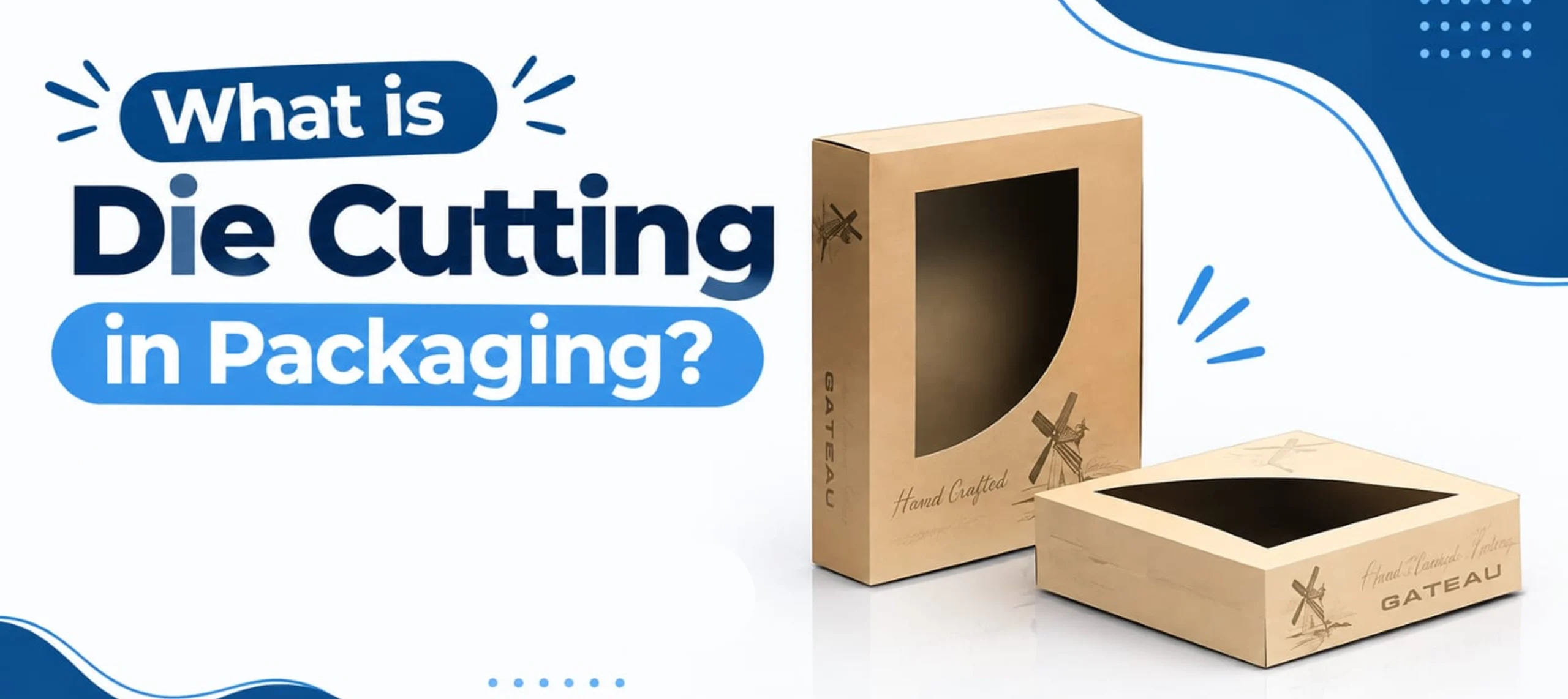
Die cutting is a manufacturing process that uses a custom made cutting tool, the die, to cut flat board into a specific shape. The comparison everyone reaches for is a pastry cutter, and it holds up reasonably well, except that a packaging die does several jobs at once rather than only cutting.
A single die carries several different types of steel rule, each doing something different to the board as the press comes down. Through cutting rules cut the sheet clean through and define the outside edge of your blank. Creasing rules do not cut at all. They press a channel into the board so it folds cleanly and predictably in the right place.
Scoring rules make a shallower single impression. Perforating rules cut a broken line of small slits, so a tear strip or a hang tab detaches when someone pulls it.
That combination is the reason die cutting exists as a process. Your box, its fold lines, its slots, its window aperture and its tear strip all get made in a single pass of the press, in perfect register with one another, and then repeated identically for the rest of the run. Cut the same shape a thousand times with a blade and a ruler and you would get a thousand slightly different boxes.
How is a cutting die actually made?
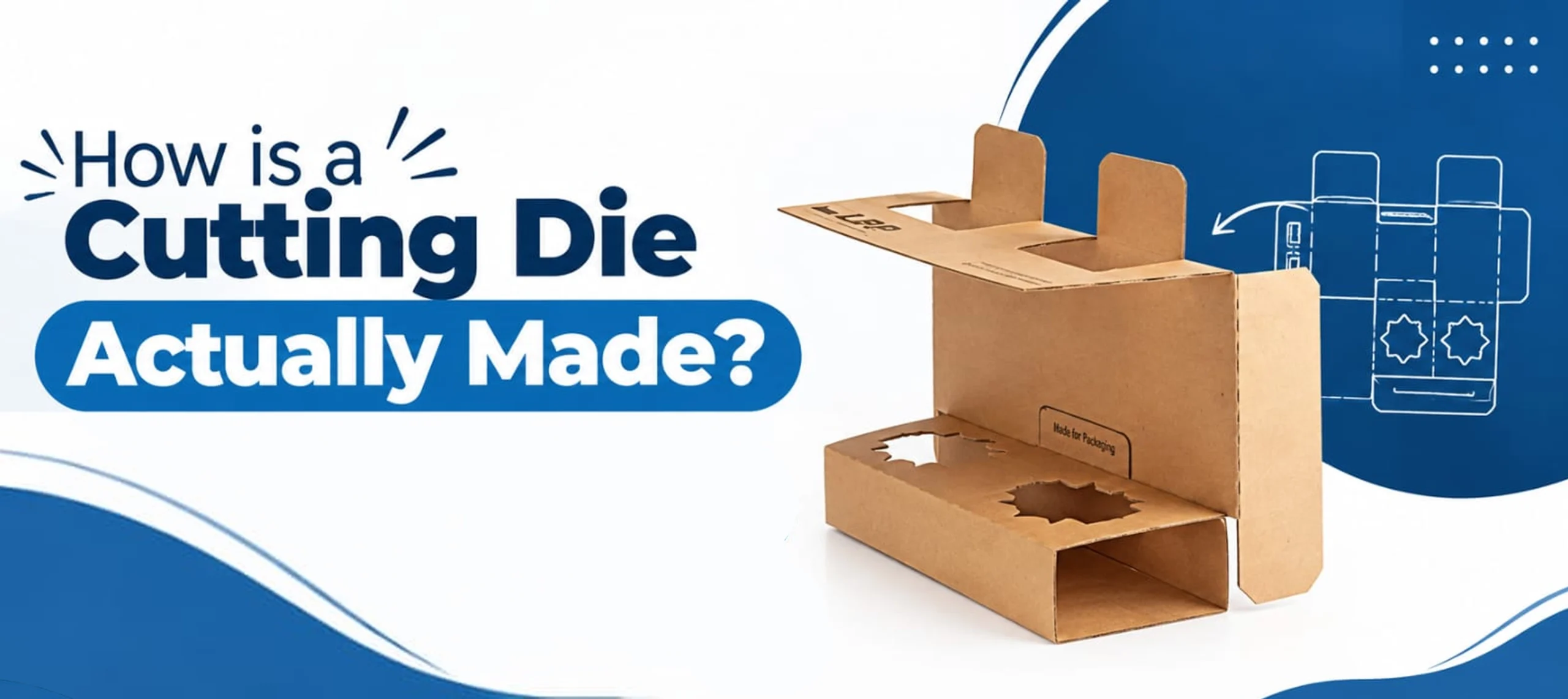
A cutting die is built by hand from a wooden board and shaped steel strip, and this is the part of the process that takes time.
A laser cuts a pattern of narrow slots into a plywood die board, following exactly the lines on your dieline file. Steel rule, which is thin hardened strip sharpened along one edge, goes through a rule bending machine to match each curve and corner, and a die maker then knocks each length into its slot by hand.
Rubber or foam sits on the board either side of the cutting edges. Its only job is to push the board back off the blade after each stroke so the sheets do not jam.
Worth knowing: the rules blunt with use. UK supplier Challenge Packaging notes that heavily used tools can need a re rule part way through their working life, which is a real cost that sits with the supplier rather than showing up on your invoice, but it is the reason tooling is not stored indefinitely.
Flatbed, rotary or digital: which cutting method suits your order?
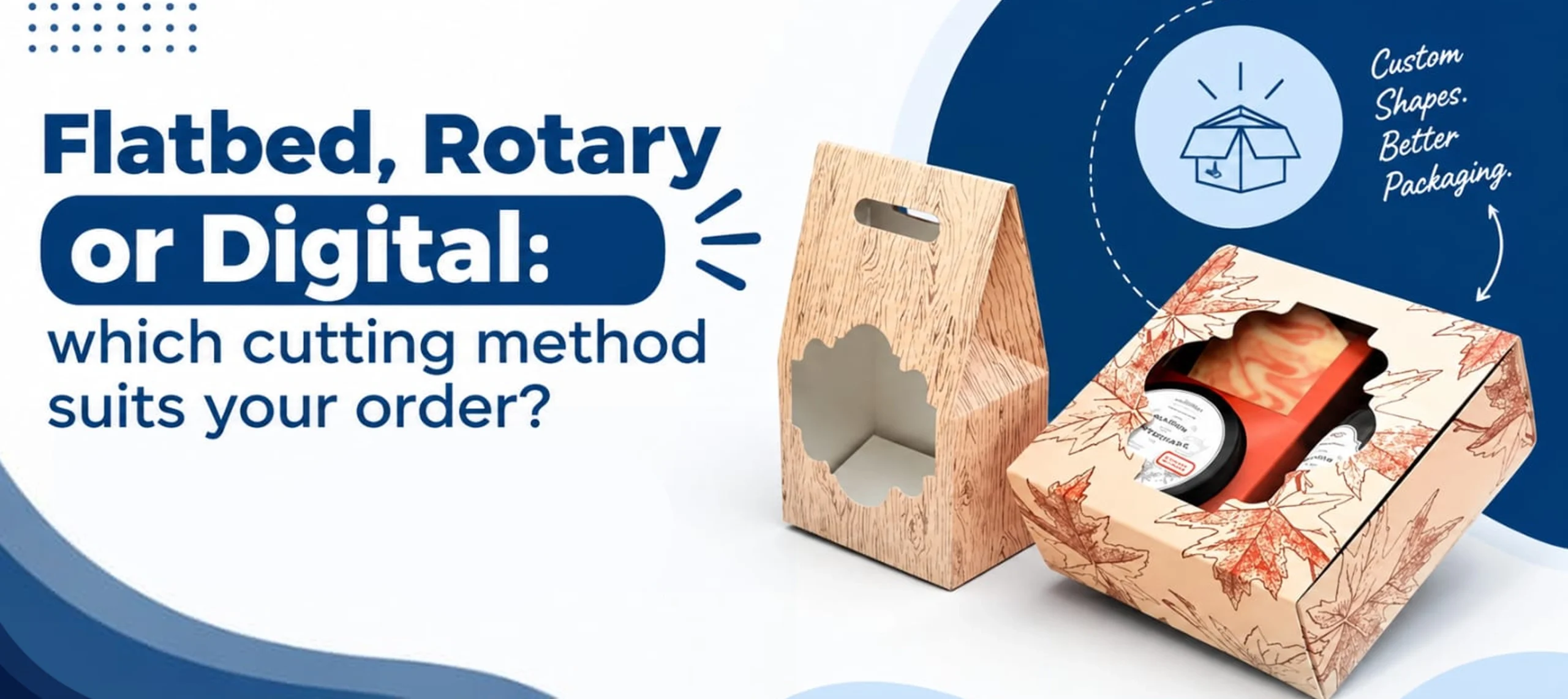
There are three ways to cut a box, and the honest answer for a small UK brand is usually flatbed for a first custom run and digital for anything genuinely short. The table below is the comparison the buyer side of this decision actually needs, because the technical guides tend to compare the machines rather than what each option does to your quote.
| Flatbed die cutting | Rotary die cutting | Digital and laser cutting | |
|---|---|---|---|
| How it cuts | Flat die pressed straight down onto a stationary sheet | Curved die wrapped round a cylinder, board fed through continuously | Computer guided blade or laser follows the file with no tool at all |
| Physical die required | Yes, one per shape | Yes, one per shape, and it costs more than a flatbed die | No |
| Typical volume suitability | Low to high volumes, the general purpose option | High volume repeat production | Samples, prototypes and short runs |
| Tooling cost treatment | One off cost per shape, reusable on repeats | One off cost per shape, higher than flatbed | None, there is no tool to buy |
| Effect on first order lead time | Die must be built before production starts | Die must be built before production starts | No die making stage at all |
| Effect on repeat order lead time | Faster, the supplier reuses the existing die if nothing changes | Faster, the supplier reuses the existing die if nothing changes | Unchanged, every run is the same |
| Shape complexity | Handles intricate shapes and tight detail well | Better suited to simpler, more regular shapes | Handles almost any shape, including one offs |
| Best for | Most custom retail and mailer boxes | Large corrugated runs with a stable design | Testing a shape before committing to a die |
The row that changes decisions is the third one from the bottom. Digital cutting has no die making stage, so a short run does not carry the days that a steel tool adds to a first order, and that is usually a bigger deal to a small brand than the cutting speed of the machine itself.
What does a cutting die cost, and who pays for it?
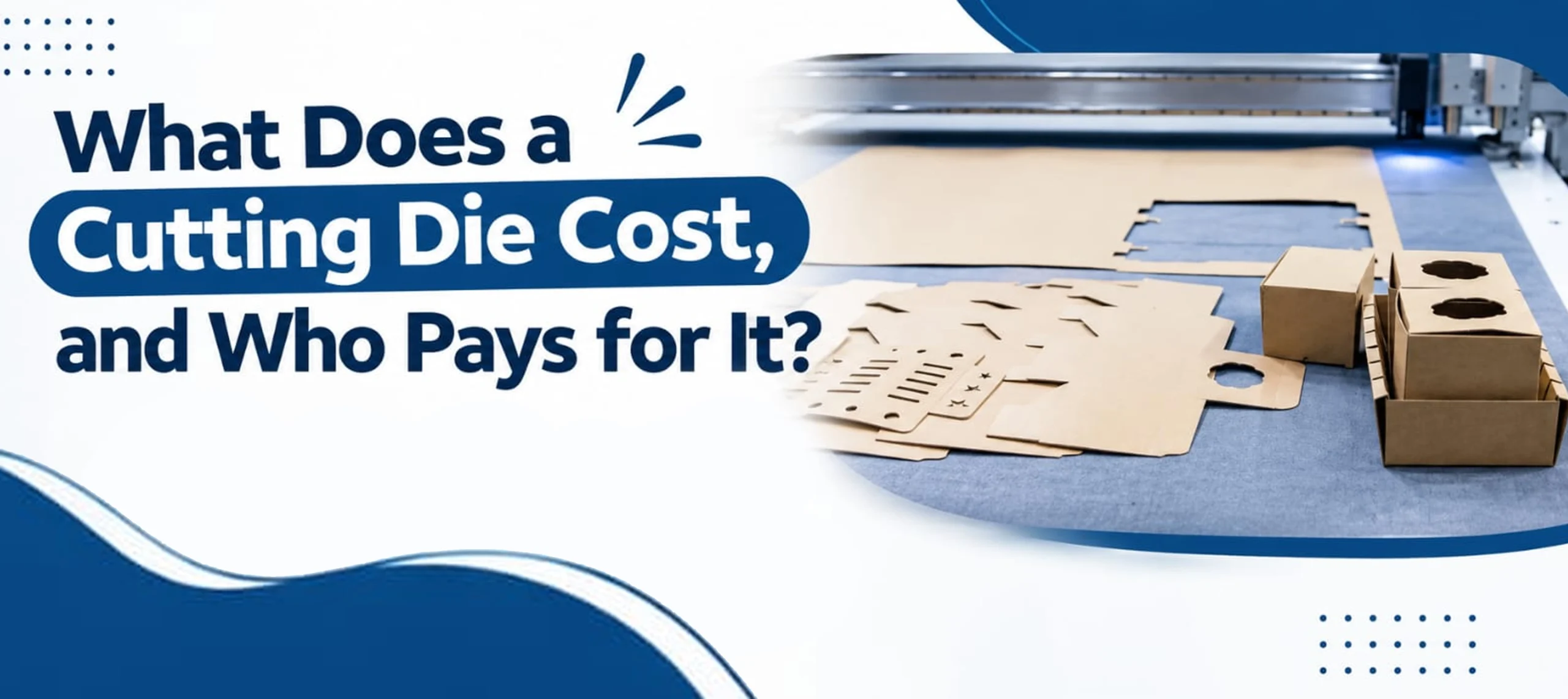
A bespoke cutting forme is a one off charge in the UK packaging trade, and the published figures cluster in the low hundreds of pounds rather than the thousands. Sarcina Packaging states that die formes typically range from £150 to £700 plus VAT, which is the clearest sterling figure we could find from a UK supplier publishing its own numbers.
Two things make that figure move. The first is how much steel rule the shape needs, so a plain tuck end carton uses far less rule than a shape with curves, a window and an integrated insert. The second is size, because a larger blank simply needs a bigger board and more rule to go round it.
How that cost reaches you depends entirely on the supplier, and this is where quotes stop being comparable. Some itemise tooling separately on the quotation, which is transparent but means you see a charge before you see a box. Others fold it into the unit price, which looks tidier on a first order and can mean you keep paying for a tool the factory finished years ago.
There are no setup fees at All Custom Packaging, so tooling does not appear as a separate charge on our quotes at all.
One caveat before you use any of these figures. They describe the general UK market rather than a price list, and a die for an unusual structure can sit outside that range in either direction. If you are comparing two quotes, ask each supplier directly whether tooling is itemised, absorbed or built into the unit price, because the same total can look three different ways on paper.
For the wider picture on how fixed costs behave as your order grows, our guide to custom packaging costs and MOQs covers the economics of quantity in detail and this post does not repeat it.
How does die making affect your lead time?

Die making sits before production in the schedule, not next to it, so it adds days to a first order that a repeat order on the same shape does not carry.
Published supplier figures for building a new cutting tool commonly fall somewhere between two and seven working days once the dieline is signed off, though these are individual suppliers describing their own workflows rather than an industry standard, and none of them is a figure you should hold a supplier to without asking. What is consistent across every source we checked is the sequence. Artwork and dieline get approved, the die gets built, then the job goes on press. Nothing about the print stage starts moving until the tool exists.
At All Custom Packaging, standard production takes 6 to 8 business days after approval. Read that as the production window rather than the whole calendar, because die making, artwork approval and delivery all sit outside it.
Here is the practical version of all that, which is the thing to plan a launch date around.
| Order type | Die making stage | What it means for your schedule |
|---|---|---|
| First order, new bespoke shape | New die built before production | The longest lead time you will have on this product |
| Repeat order, nothing changed | Existing die reused | Shortest lead time, the tooling stage is already done |
| Repeat order, size or shape changed | New die needed | Treat it as a first order again, not a repeat |
| Repeat order, artwork only changed | Existing die reused | Print plates may change, the cutting tool does not |
| Short run on digital cutting | No die at all | No die making stage in the schedule |
The row people get caught by is the third one. Changing your box by 5mm is not a small change from the factory’s point of view, it is a new tool, and a launch plan built on your last lead time will be wrong.
Do you need a custom die, or will an existing one do?
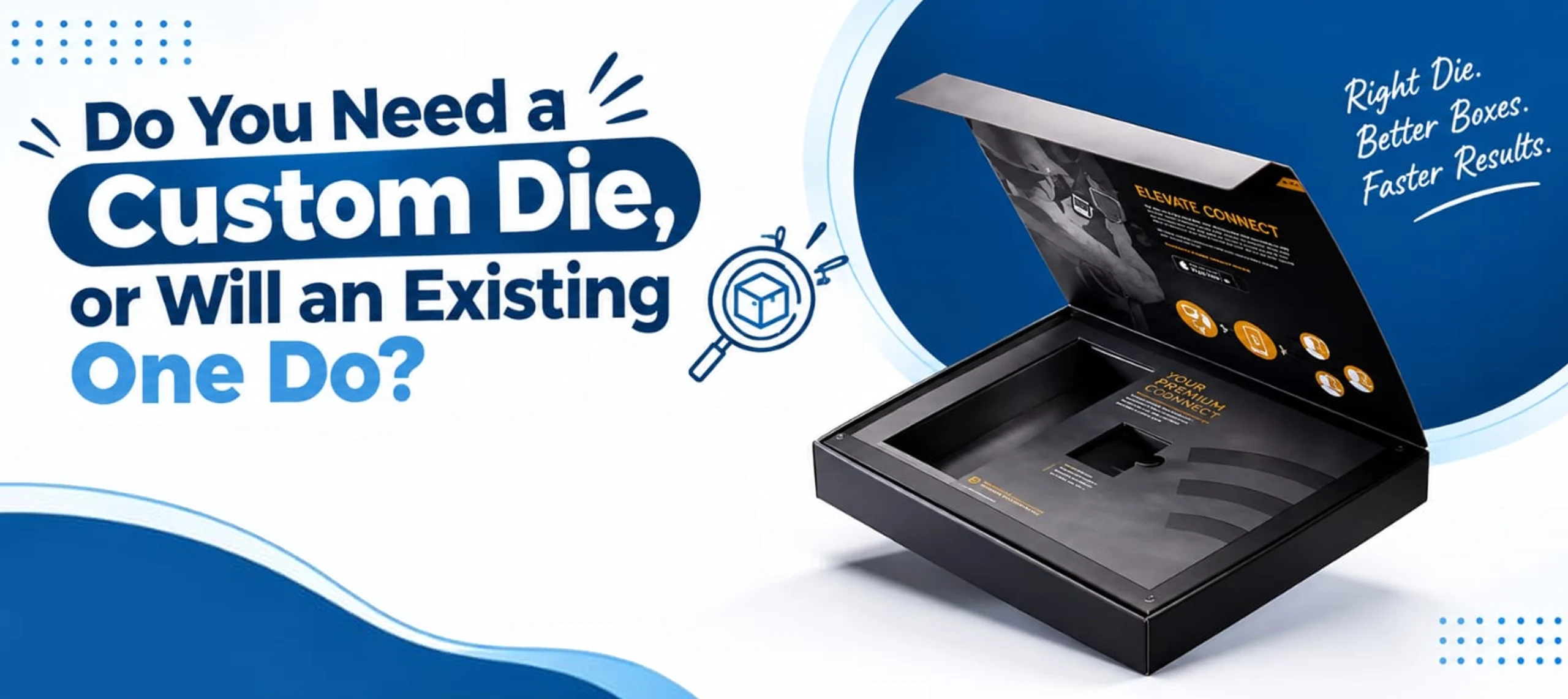
Not every custom box needs a bespoke tool. Most suppliers hold cutting dies for standard structures in common sizes already, and if one of those fits your product you get a printed custom box with no new tooling and no tooling stage in the schedule.
An existing die makes sense when your product fits a standard structure at a size the supplier already holds, when you are testing a market and do not want to commit, or when speed matters more than a millimetre perfect fit.
A bespoke die earns its place when the internal dimensions genuinely have to be exact, when the structure itself is part of the design, such as a magnetic closure or an integrated insert, or when you will reorder the same shape often enough that the tool works hard for its money.
The dimension question is the one to be honest with yourself about. A box that is 10mm too big needs more void fill and protects the product less well, so on a fragile item the bespoke tool pays for itself. On a T shirt, it very often does not.
Ask your supplier one specific question before assuming you need new tooling: do you already hold a die close enough to this? The answer is free and it is surprisingly often yes.
How long is a die kept, and can you take it with you?
The supplier who makes your cutting die also keeps it, for a defined period, and it is not usually yours to take elsewhere.
Published UK storage policies vary. Challenge Packaging states it keeps tooling and print origination for 18 months, after which unused tooling may be destroyed without prior notice. Sarcina Packaging describes tooling as usually stored by the manufacturer for up to three years before disposal. Both are individual company policies rather than a trade standard, so treat them as a range to ask about rather than a rule you can rely on.
The practical consequence is that a long gap between orders can quietly reset you to a first order lead time. If you order seasonally and the gap is over a year, it is worth a quick email to confirm the tool still exists before you build a launch date around a repeat order timeline.
When does digital or laser cutting beat a steel die?
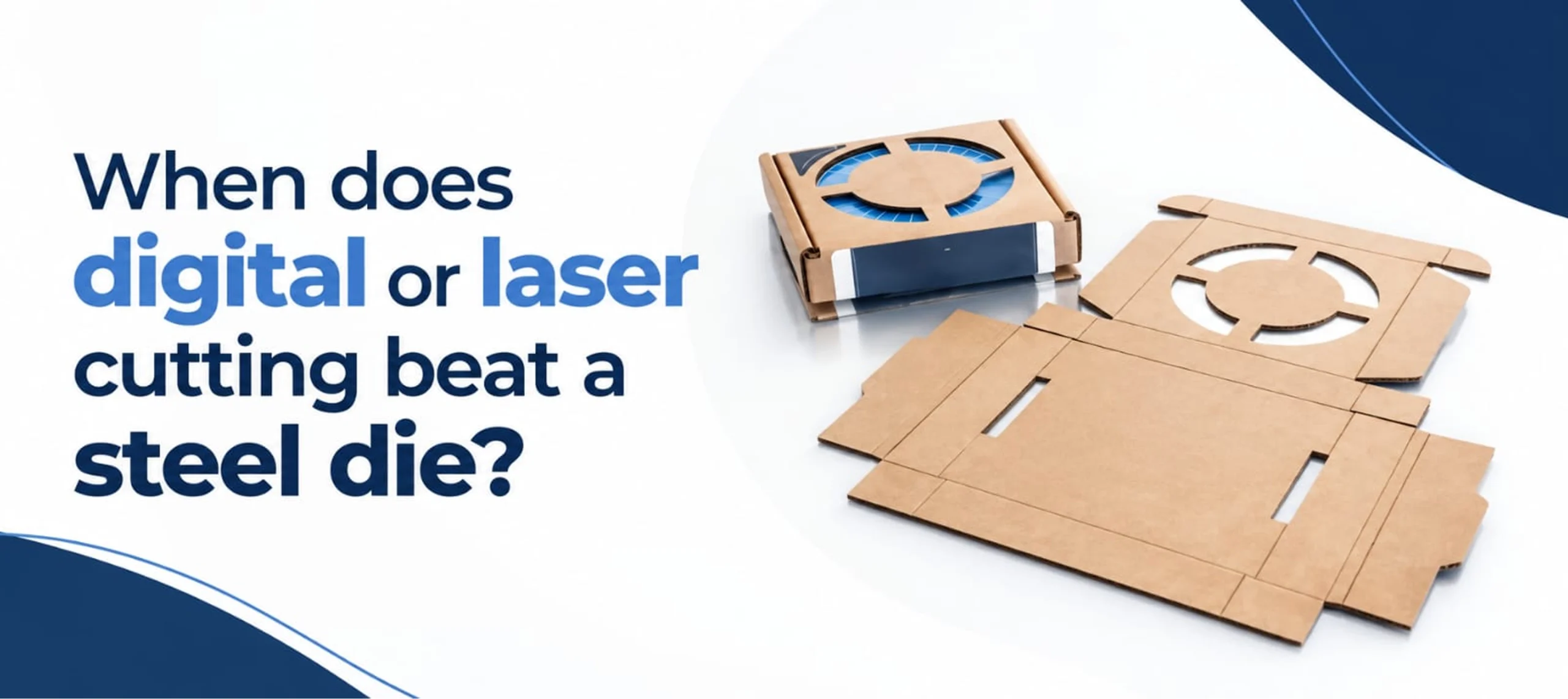
Digital cutting uses a computer guided blade or laser that follows your file directly, with no physical tool to make, which removes both the tooling cost and the die making days from the schedule. For very short runs, samples and prototypes, that is a genuine advantage rather than a technicality.
The trade off is throughput. A steel die cuts a full sheet in one stroke, while a digital cutter traces every line individually, so as quantities climb the die based route pulls ahead on both speed and cost per unit. Esko and Zünd build the cutting tables that do this work, and both have marketed the technology as a short run alternative to conventional die cutting for years rather than as a replacement for it.
One honest note on the 2026 picture, since this topic is full of five year old articles that quietly get reused. We could not verify from a primary source that the economics of digital cutting have shifted materially since around 2021.
Market research summaries claim the segment is growing faster than the wider die cutting market, but we could not open the underlying reports to check their methodology, so this post does not assert a change it cannot evidence. The structural advantage has not changed either way: no tool means no tooling cost and no tooling wait, and that holds now exactly as it did then.
For a small UK brand this usually shows up as one decision. If you want to hold a physical version of a new structure before committing to a die, digital cutting is how that gets made without buying tooling for a shape you might still change.
What die cutting means for your artwork and finishes
Die cutting is the reason bleed exists. Your artwork needs to run past the cut line, because a press has real tolerances and a sheet that shifts fractionally would otherwise show a white sliver along the edge.
Two things follow from that for anyone preparing files. Keep important artwork and text away from cut and crease lines, and supply your file on the supplier’s own dieline rather than a redrawn version. Our print ready artwork checklist covers bleed values, colour mode and file formats properly, and it is the page to work from when you are about to submit.
Finishing is a separate stage with separate tooling. Embossing, debossing and foil stamping each use their own die, which is not your cutting die and which a supplier quotes separately. Our guide to packaging print finishes covers how those are chosen and priced. Board choice matters here too, because heavier flutes crease differently from fine ones, and our cardboard grades and flutes guide explains what each grade does.
If you want a shape checked before you commit to anything, design support is free and a digital 3D mock up is free, so you can see the structure resolved on screen before a tool exists. Ask us for a quote and tell us the product dimensions rather than the box dimensions, because that is the information that decides whether an existing die will do the job. Orders start from 100 units, and UK delivery is free.
Frequently asked questions

What is the die cutting process in simple terms?
A press drives a shaped steel tool, the die, through flat board to cut your box out, along with its fold lines, slots and any window, in a single stroke. Your supplier builds the die for your box shape from your dieline before production starts, then reuses it for every sheet in the run.
How much does a cutting die cost in the UK?
UK supplier Sarcina Packaging publishes a typical range of £150 to £700 plus VAT for a die forme, with the figure depending mainly on how much steel rule the shape needs and how large the blank is. It is a one off cost per shape rather than a per order charge. There are no setup fees at All Custom Packaging.
Is die cutting a one off cost or do I pay every time?
It is a one off cost per shape in the packaging trade generally, because the same die runs again on repeat orders as long as nothing about the size or structure changes. How a supplier presents it varies, so ask whether tooling is itemised separately or built into the unit price before comparing quotes.
How long does it take to make a cutting die?
Individual UK and international suppliers publish figures of roughly two to seven working days from dieline approval, though these are company workflows rather than an industry standard. The important point is sequencing: the die is built before production begins, which is why a first order on a new shape takes longer than the repeat that follows it.
What is the difference between a dieline and die cutting?
A dieline is the flat artwork template showing cut, fold and glue lines. Die cutting is the physical process of pressing a steel tool through board to make those cuts. The dieline is the file, the die is the tool built from it, and the two words are not interchangeable.
What is the difference between scoring, creasing and perforating?
Different rules set into the same die do all three. Creasing presses a channel so board folds cleanly, scoring makes a shallower single impression, and perforating cuts a broken line of slits so a section can be torn away by hand. Only through cutting rules cut the sheet completely.
Do I need a custom die for my box?
Not always. Most suppliers hold dies for standard structures in common sizes, and if one fits your product you get a custom printed box with no new tooling and no tooling stage in the schedule. A bespoke die is worth it when internal dimensions must be exact, when the structure itself is part of the design, or when you will reorder the same shape many times.
Can I get boxes die cut without buying a die?
Yes, for short runs. Digital and laser cutting follow your file with a computer guided blade or laser and need no physical tool, which removes both the tooling cost and the die making days. Throughput is lower, so as quantities rise a steel die becomes the cheaper route per unit.
How long does a supplier keep my cutting die?
It varies by company rather than following a trade standard. Published UK policies range from 18 months to around three years, after which unused tooling may be disposed of. If you order seasonally with long gaps, confirm the tool still exists before planning a repeat order lead time.