
Coffee Labelling Requirements UK: What the Bag Must Show
A bag of roasted coffee sold prepacked in the UK must show what it is, such as “ground coffee”, its weight, a best-before date, and the name and postal address of the business behind it. Add a lot mark if the date does not show the day. If the bag is flushed with nitrogen or another packaging gas so the coffee keeps longer, it must also say “packaged in a protective atmosphere”.
Plain coffee needs less on its label than many foods. Beans and ground coffee need no ingredients list and no nutrition table, and a coffee-based drink with “coffee” in its name needs no high-caffeine warning. Origin is required only where leaving it out would mislead, although two of the pages ranking for this question list it as something every coffee label must show.
This guide sets out the coffee labelling requirements for roasted, ground and instant coffee sold in shops, online and in gift sets, and then shows where each line goes on the bag, the tube and the box. It follows the rules for Great Britain. Northern Ireland follows EU food labelling rules, so check the EU texts for sales there. This is general guidance, and for advice on a specific label, ask the Trading Standards team at your council.
What a coffee bag must show
GOV.UK’s guidance on giving food information to consumers lists what prepacked food must carry. For a bag of plain roasted coffee, that comes down to the lines below.
| Information | What it means for coffee | Example |
|---|---|---|
| Name of the food | A name that says what the product is, alongside any blend or brand name | Whole bean coffee |
| Net quantity | The weight in g or kg, readable together with the name from one viewing point | 250 g |
| Best-before date | “Best before” with the day, or “Best before end” with the month and year for coffee that keeps more than 3 and up to 18 months | Best before end October 2027 |
| Lot mark | A batch code, unless the date shows at least the day and the month | L2610A |
| Name and address | The business the coffee is sold under, with a postal address in the UK, the Channel Islands or the Isle of Man | Business name, street, town, postcode |
| Storage conditions | Where the coffee needs them to keep its quality, including after opening | Reseal after opening. Store in a cool, dry place. |
| Protective atmosphere | Only if a packaging gas has been used so the coffee keeps longer | Packaged in a protective atmosphere |
| Country of origin | Only where leaving it out could mislead, or where the pack gives the coffee a country | See the origin section below |
Business Companion’s guide to product names treats a blend name such as “Morning Fog” as a fancy name with no legal standing. The bag still needs a name that says what the product is, and that is the name the weight must be seen with. Annex VI of the food information regulation adds the physical condition of the food where leaving it out could mislead. For coffee, that usually means saying whether it is whole bean or ground.
The weight figures have their own minimum height under the quantity marking schedule. On 250 g, 500 g and 1 kg bags they must be at least 4 mm tall. Smaller bags, above 50 g and no more than 200 g, need 3 mm, and samples of 50 g or less need 2 mm.
The printed weight is also a promise about the contents. Bags weighed one by one must each hold at least that weight. Under the average quantity system, a batch of 250 g bags must average at least 250 g, no more than 2.5% may be over 9 g short, and none may be over 18 g short.
Article 13 sets the size for the rest of the mandatory text: a lower-case x at least 1.2 mm tall, dropping to 0.9 mm when the pack’s largest surface is below 80 cm².
What plain coffee can leave off
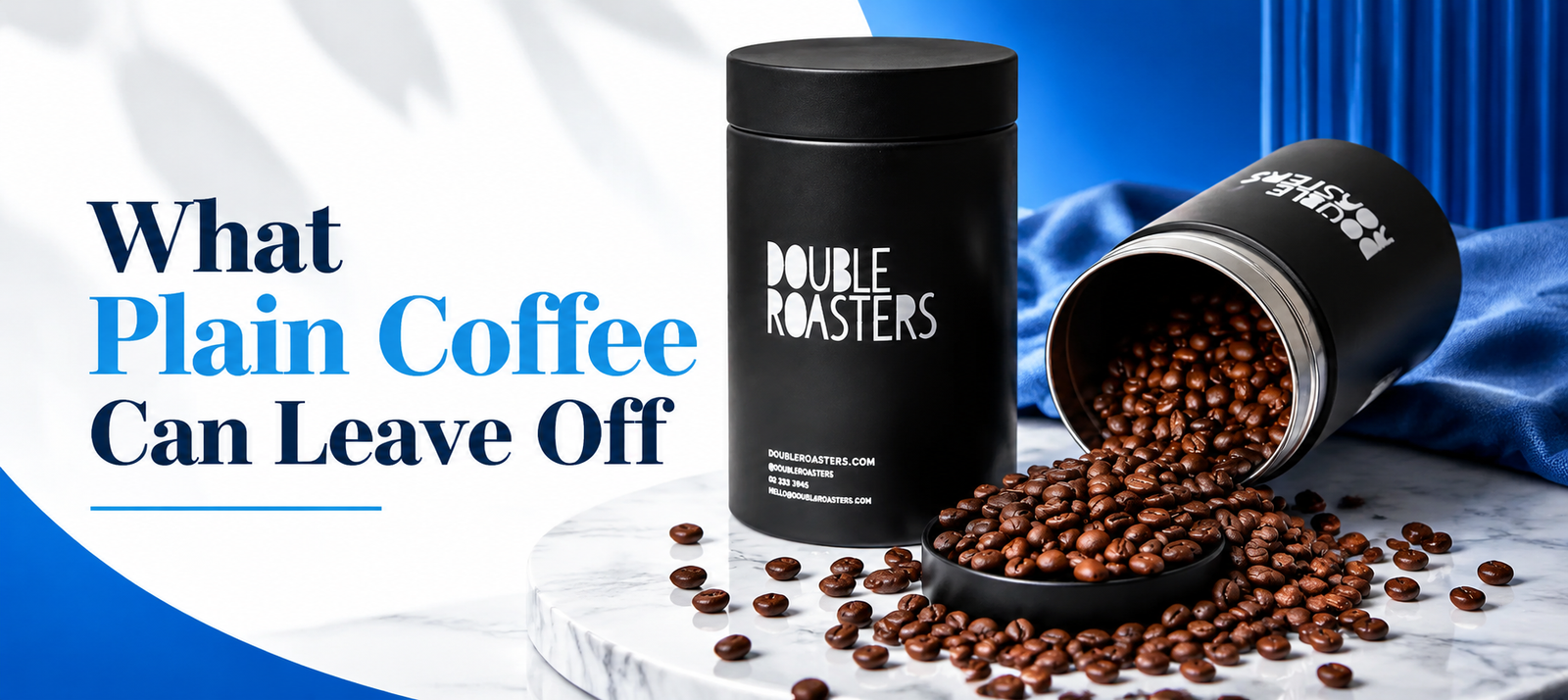
Three lines that appear on many food and drink labels are not needed on a bag of plain beans or ground coffee.
- An ingredients list. Article 19 exempts a food made of one ingredient whose name identifies it, so “ground coffee” needs no list.
- A nutrition table. Annex V exempts whole or milled coffee beans, decaffeinated beans and instant coffee from the nutrition declaration.
- A caffeine warning. The “High caffeine content” warning in Annex III does not apply to drinks based on coffee whose name includes the word “coffee”.
Each exemption stops where the coffee stops being plain. A flavoured coffee has at least two ingredients, so it needs a list under a heading containing the word “ingredients”, in descending order of weight, with any of the 14 allergens emphasised. Flavourings used in small quantities need no percentage.
The nutrition exemption has edges too. It names beans and instant coffee, so a latte sachet or a canned coffee drink needs a nutrition declaration unless another exemption applies. For flavoured beans, check with Trading Standards whether the exemption still covers them. A nutrition or health claim brings nutrition labelling in, whatever the product.
Country of origin: when the coffee must say where it is from
Coffee does not always have to state where it comes from. GOV.UK’s page on what a food label must show lists the foods that always need an origin, including meat, fish, honey, olive oil, wine, and fruit and vegetables. Coffee is not among them.
For everything else, Article 26 makes origin mandatory where leaving it out might mislead, judged on the label as a whole. Business Companion’s guide to prepacked food labelling gives a Union flag, a national recipe name and a country’s colours as examples that can suggest an origin. If the design does that, the label must state the product’s actual country or place of origin.
A second rule applies once the pack gives the coffee a country. If the pack says “Product of the UK”, or carries a flag as an origin claim, and the beans were grown elsewhere, Article 26(3) and Regulation 2018/775 require the beans’ origin as well. That can be a country, such as “coffee from Colombia”, the area “non-UK”, or a statement that the beans do not originate from the UK.
The two origins have to be readable together, from one viewing point. Where the coffee’s origin is given in words, the beans’ origin needs an x-height of at least 75% of that wording’s x-height, and never less than 1.2 mm.
Single-origin details such as the farm, the region and the altitude are voluntary information. They can sit wherever the design needs them, provided they are accurate and leave room for the mandatory lines. If you are unsure whether a line such as “roasted in Bristol” counts as an origin statement, ask Trading Standards before printing.
Best-before date, roast date and lot mark
Coffee is not on the short list of foods exempt from date marking in Annex X, so every prepacked bag needs a best-before date. The business sets the date, and its precision decides the wording:
- “Best before 14 October 2027” when the date includes the day.
- “Best before end October 2027” when it gives the month and year, which is enough for coffee that keeps more than 3 months and up to 18.
- “Best before end 2028” when it gives the year alone, which is enough for coffee that keeps longer than 18 months.
A roast date is extra information. “Roasted on 14 October 2026” tells buyers how fresh the coffee is, but it does not replace the best-before date, and the bag still needs one of the forms above.
Business Companion’s date and lot marking guide explains how the date and the lot mark interact. A date showing at least the day and the month can serve as the lot mark. A “Best before end” date, which has no day, cannot, so the bag needs a separate code, starting with “L” where it could be confused with other figures.
Because the date and lot change with every roast, they rarely belong in the printed artwork. Leave a clear panel for a stamp or a small label, or print “Best before end: see base” and mark the base, since Annex X allows a pointer to where the date is given. Keep price stickers off that panel.
Gas-flushed bags and storage advice
If you flush bags with nitrogen or another packaging gas so the coffee keeps longer, Annex III requires the words “packaged in a protective atmosphere”. The statement is tied to the use of a packaging gas, so it belongs only on bags that are actually flushed.
Storage advice is needed where the coffee requires particular conditions to keep its quality, and Article 25 adds conditions or a time limit after opening where appropriate. A line such as “Reseal after opening and store in a cool, dry place” covers both. Business Companion suggests placing it close to the best-before date.
Instant coffee and decaf: names set by law
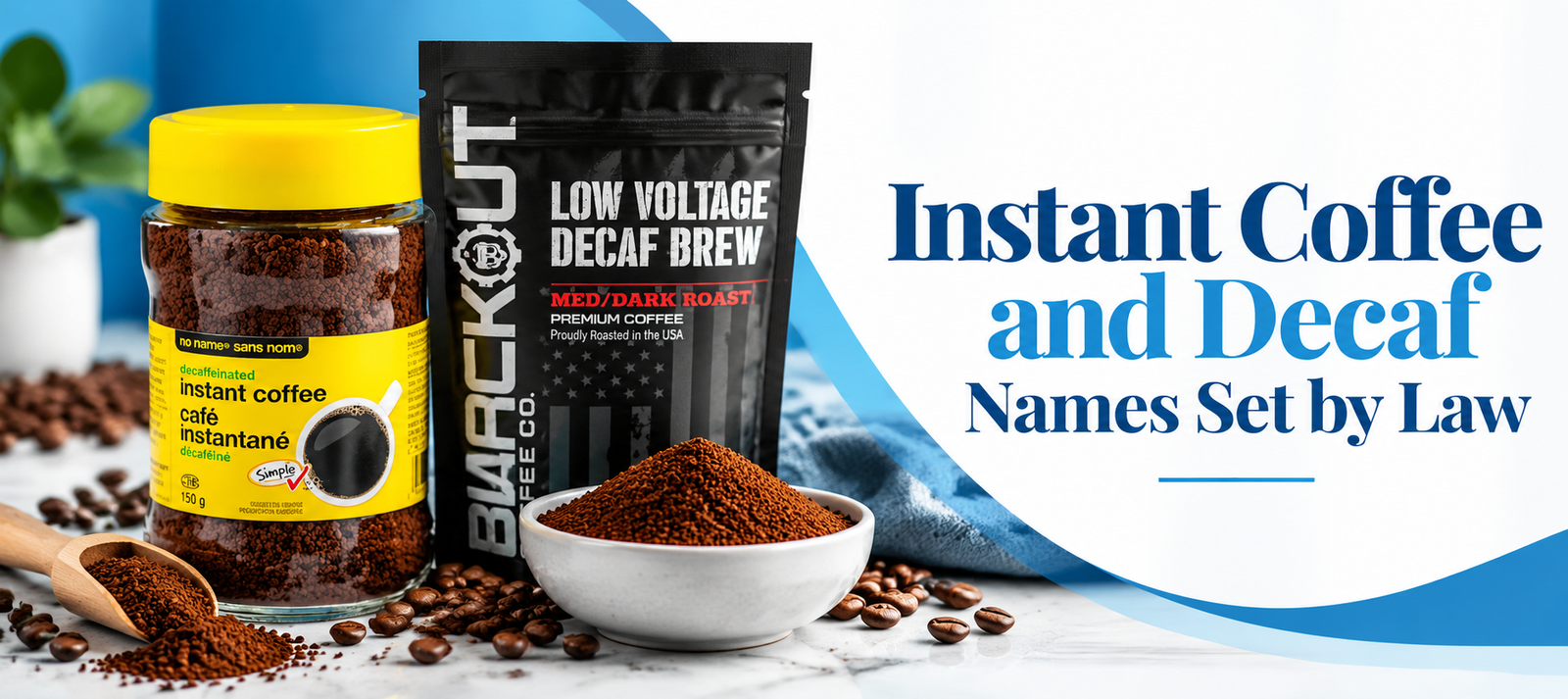
Instant coffee is the part of the range with a name fixed by law. The Coffee Extracts and Chicory Extracts (England) Regulations 2000 reserve four names, “coffee extract”, “soluble coffee extract”, “soluble coffee” and “instant coffee”, for extracts that meet set levels of coffee-based dry matter.
| Form | Coffee-based dry matter | Name on the label |
|---|---|---|
| Powder, granules, flakes or cubes | At least 95% | One of the four reserved names |
| Paste | 70% to 85% | The name plus “paste” or “in paste form” |
| Liquid | 15% to 55%, with added sugar products up to 12% | The name plus “liquid” or “in liquid form” |
Paste and liquid extracts must also declare their minimum coffee-based dry matter as a percentage. A liquid extract made with sugar must say so with wording such as “with added X”, naming the sugar product, readable together with the name. Above 25% dry matter, a liquid extract may add “concentrated” to its name.
“Decaffeinated” on instant coffee means the residual anhydrous caffeine is no more than 0.30% of the coffee-based dry matter, and the word must be readable together with the name. These Regulations cover coffee and chicory extracts only. They set no caffeine figure for decaffeinated beans or ground coffee, which fall under the general rule that a label must not mislead.
The rules do not cover mixes in which instant coffee is one ingredient, such as a sachet with milk and sugar. Wales, Scotland and Northern Ireland have their own 2001 Regulations with the same names and limits: Wales, Scotland and Northern Ireland. Together they replaced the coffee and coffee products regulations of 1978 and 1979, and amendments to those older rules still turn up in search results.
Organic and certification marks
Organic is a protected word. Under GOV.UK’s organic labelling rules, coffee can be labelled organic only when at least 95% of its agricultural ingredients are organic and the businesses handling it are certified by an approved UK control body.
The label then carries the control body’s code, in the form GB-ORG-XX for products labelled in Great Britain, and a statement of agricultural origin. Coffee grown outside the UK takes “Non-UK Agriculture”. GOV.UK advises having the label approved by your control body before it is printed.
Certification marks such as Fairtrade or Rainforest Alliance are used under each scheme’s own rules, so check them with the scheme before the artwork is final. Like any voluntary information, they must not cover or crowd the mandatory lines.
Laying out a valve bag, a tube and a gift set
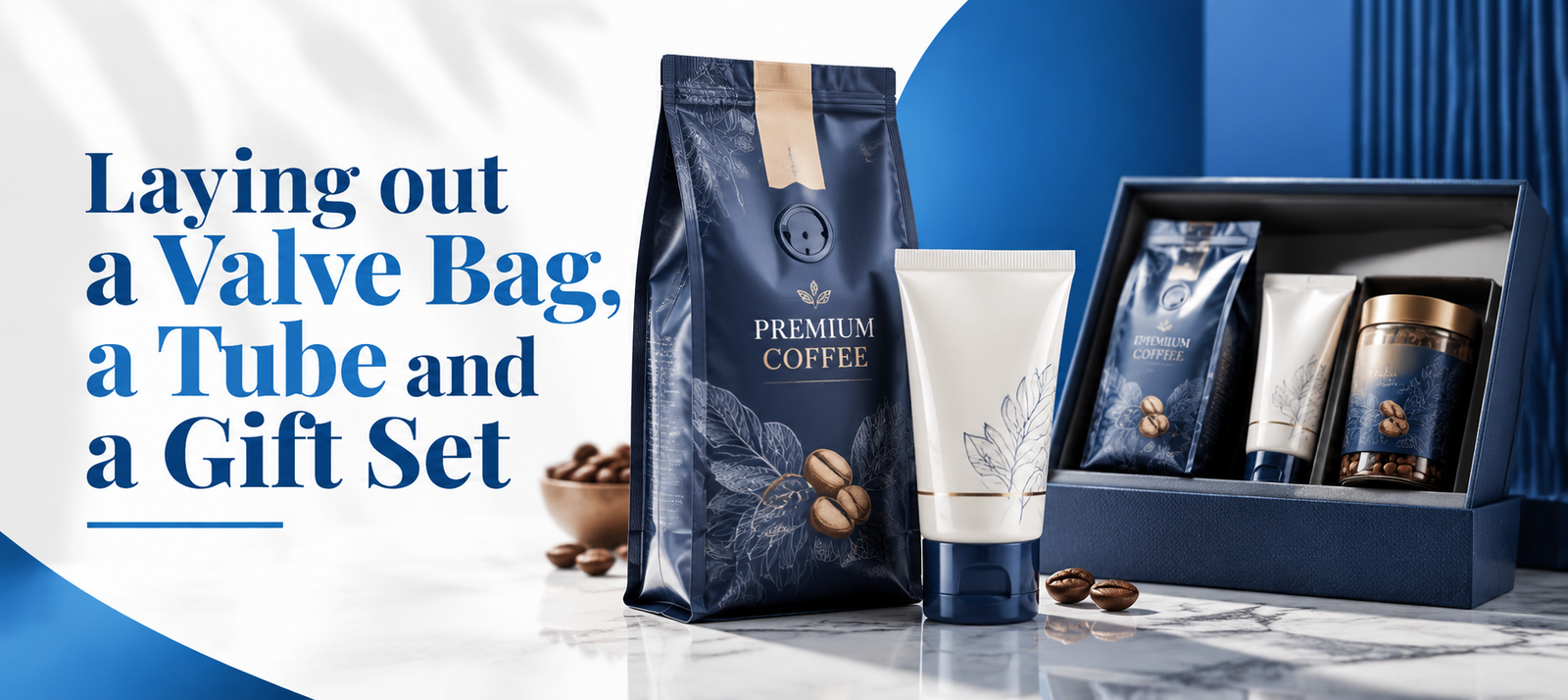
Two rules fix the layout. The name and the weight must share a field of vision, which Article 2 defines as all the surfaces of a package that can be read from a single viewing point. Article 13 then bars anything that hides or interrupts the mandatory text, and Business Companion adds that it cannot sit on a part that must be unfolded or opened to be read.
On a valve bag, that works out as:
- Front: the blend or brand name, the name that says what the coffee is, and the weight. If that name moves to the back, the weight moves with it.
- Back: the business name and postal address, the date and lot mark or a pointer to them, storage advice, and any origin, organic or ingredients lines.
- Keep clear: the valve, the zip, the heat seals, the gusset folds and the tin-tie, where text could be hidden or broken up.
- After that: tasting notes, brew guides and the farm story. Instructions for use are required only where the food would be hard to use properly without them.
Business Companion says voluntary information must be cut back if it leaves too little room for the mandatory lines at the minimum size. Measure the x-height and the weight figures on a printed proof, and our guide to print-ready artwork covers the other checks before a run.
Our range includes coffee bags with one-way degassing valves, tin-ties and resealable or zip closures, in foil and high-barrier constructions. In the Coffee Packaging category, Black Kraft Coffee Bags are printed kraft bags whose construction is set by the specification rather than being one fixed laminate. A fully printed bag can carry every fixed line, while the date and lot go on a stamp or small label for each roast.
The bag is the part the coffee touches. Food-contact material suitability is confirmed for the specific material before production. The artwork layout can reserve clear panels for the information the product is required to display. All Custom Packaging can help organise the available print space, but the brand or its regulatory adviser remains responsible for confirming the accuracy and completeness of the required product information.
On coffee tube packaging, the curve decides the field of vision. Put the name and the weight side by side on one face of the tube, not on opposite sides, so a buyer can read both from one viewing point.
A Christmas gift set sold closed counts as one prepacked item, so its information must be readable without opening it. That means printing it on the box, sticking a label on the outside, or cutting a window that shows each bag’s own label.
For identical bags, the box gives one bag’s weight and the number of bags, as in “3 x 250 g”. That is not needed when the bags can be counted and one weight read from outside (Annex IX). For different coffees not sold separately, the box gives the total weight and the number of bags instead.
Business Companion recommends repeating the lot mark on the outside of a presentation box, so a recall does not mean opening every set. Our gift boxes can be printed with that outer panel, and our guide to gift box sizes explains how to size one around the bags. Inserts are cut to the product’s own dimensions, so movement inside the box is controlled.
A subscription parcel works differently. The bag inside is the prepacked item and carries the full label, while coffee shipping boxes are there to get it to the door intact. Our guide to subscription box packaging covers the outer box.
Selling online, in your own café and through stockists
Before selling through any of these routes, the roastery has to register as a food business with its council. The FSA’s registration guidance on GOV.UK applies to roasting at home and selling only online as well, and in England, Wales and Northern Ireland asks for registration at least 28 days before the first sale.
For prepacked coffee sold online, Article 14 requires the mandatory information, apart from the best-before date, to be available before the purchase is completed, at no extra cost. Everything, the date included, must be there at delivery. Business Companion recommends showing it on the same page as the product.
Bags you pack and sell from the same premises, or from your own stall or van, are “prepacked for direct sale”. Business Companion’s PPDS guide requires the food’s name and a complete ingredients list in which allergens are emphasised. A food that needs no ingredients list carries a “contains” statement for any allergens present instead.
Printing the full prepacked label on every bag lets one design serve the café shelf, the online shop and a stockist. Bags sold to a shop or café that resells them are prepacked, not prepacked for direct sale, so they need the full label. Some stockists also want a barcode, and our guide to QR codes and barcodes on packaging explains when one is needed.
Common mistakes
- A blend name with no name saying what the coffee is.
- The weight on a different face from that name.
- A roast date printed instead of a best-before date.
- A month-and-year “Best before end” date with no lot mark.
- An email address or phone number in place of a postal address.
- A gas-flushed bag without “packaged in a protective atmosphere”.
- “Decaffeinated” on instant coffee printed away from the name.
- Mandatory text under the valve, across a seal or inside a closed gift box.
- Organic wording with no control body code or agricultural origin statement.
Frequently asked questions
What needs to be on a coffee label in the UK?
For plain roasted coffee sold prepacked: its name, the net weight readable together with it, a best-before date, a lot mark if the date lacks the day, and the business’s name and postal address. Storage advice, the origin and the protective atmosphere statement are added when they apply.
Does coffee need a nutrition label?
Not for whole or ground beans, decaffeinated beans or instant coffee, which Annex V exempts. Mixes such as latte sachets and ready-to-drink coffee must carry one unless another exemption applies, as must any pack making a nutrition or health claim.
Is country of origin mandatory on coffee?
Only where leaving it out could mislead buyers about where it comes from. If the pack does give the coffee a country and the beans were grown elsewhere, the beans’ origin must appear too, readable from the same viewing point.
Can a roast date replace the best-before date?
No. Coffee is not exempt from date marking, so the bag needs “Best before” or “Best before end” with a date, and the roast date can sit beside it as extra information.
What does decaffeinated mean on instant coffee?
Residual anhydrous caffeine of no more than 0.30% of the coffee-based dry matter, under the coffee extract regulations in each UK nation. Those rules set no figure for decaffeinated beans or ground coffee.
Does a coffee drink need a high-caffeine warning?
Not when it is based on coffee and its name includes the word “coffee”, as Annex III exempts those drinks. Beans and ground coffee are not drinks, so the warning does not arise for them.
Roasting for Christmas sets or a subscription run? Our stickers and labels can carry the full mandatory panel on stock bags, or just each roast’s date and lot, and the bags and boxes above can be printed with your layout. Our guide on when to order Christmas packaging lists lead times by packaging type. Orders start from 100 units. Design support is free. A digital 3D mock-up is free. For the quote, send the artwork, the quantity, the delivery postcode and the date the order is needed by.